


Why Europe Onshore Wind Repowering Could Reshape Renewable Power
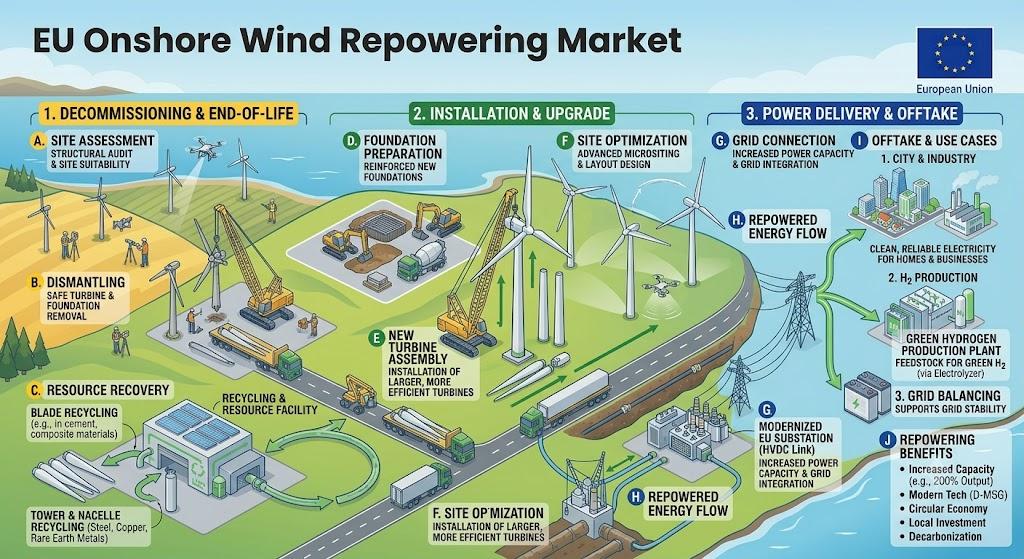
Europe Onshore Wind Repowering Market: How Technology Is Redefining Existing Wind Farms
Europe Onshore Wind Repowering Market is increasingly shaped by technological progress. The wind turbines installed across Europe’s mature onshore projects were designed for an earlier generation of renewable power development. Today, improvements in rotor design, generator efficiency, digital controls, forecasting, and condition monitoring are changing what established sites can produce.
Repowering is not simply a matter of removing an old turbine and installing a new one. It is an opportunity to redesign the operating concept of a wind farm around current technology. Developers can reassess turbine spacing, hub height, rotor diameter, electrical systems, access roads, foundations, and control strategies. The resulting project can be substantially different from the original installation while remaining connected to the same broad location.
A detailed Europe Onshore Wind Repowering Market Analysis helps frame these changes through technology, investment, infrastructure, and project development perspectives. For stakeholders, understanding these dimensions is important because the most attractive repowering opportunity depends on site-specific conditions rather than turbine technology alone.
Rotor diameter is one of the most influential developments. Larger rotors allow turbines to sweep a wider area and capture more wind energy. This can be particularly valuable at sites where wind speeds are moderate or variable. Higher hub heights can further improve access to stronger and more consistent wind resources, although they may introduce planning, aviation, and visual considerations.
Modern turbine controls also improve performance. Advanced software can continuously adjust operating parameters to respond to wind conditions. Digital systems support better forecasting, performance analysis, and fault detection. When combined with sensors and remote monitoring, these capabilities can reduce unplanned downtime and help operators identify performance losses earlier.
Condition monitoring is particularly relevant to aging assets. Older turbines can experience component wear involving gearboxes, bearings, generators, electrical systems, and blades. Newer platforms often incorporate more sophisticated monitoring and diagnostics. During repowering, developers can replace vulnerable components with systems designed for improved reliability and easier maintenance.
Artificial intelligence and data analytics are adding another layer. Historical operating data can reveal underperformance patterns, while predictive models can estimate future maintenance needs. Developers can compare alternative turbine layouts and production scenarios before construction. This supports better investment decisions and can reduce uncertainty during project planning.
Electrical technology is also evolving. Modern turbines may operate at higher power ratings, requiring careful assessment of transformers, substations, cables, protection systems, and grid interfaces. Repowering can therefore trigger electrical upgrades even when the basic site connection remains valuable. Coordinating these changes early can prevent delays and unexpected costs.
A mature project might be replaced by a smaller fleet of high-capacity machines. Fewer turbines can simplify certain maintenance activities and potentially reduce visual clutter, although each site must be evaluated independently.
Environmental monitoring technology can support more informed development. Radar, acoustic systems, cameras, and automated data platforms can help assess birds, bats, noise, and other site conditions. Better evidence may improve operational decisions and support environmental management plans.
Technology selection should ultimately follow project objectives. A developer focused on maximizing annual generation may choose a different configuration from an owner prioritizing grid stability, community acceptance, or construction simplicity. Financial models must incorporate technology assumptions rather than treating turbine capacity as the only performance measure.
As European wind assets mature, technological innovation is transforming the economics of existing sites. Europe Onshore Wind Repowering Market is therefore becoming a field where engineering, digitalization, asset management, and development strategy converge. The projects most likely to succeed will be those that use modern technology to solve site-specific constraints while maintaining disciplined attention to cost, permitting, grid requirements, and long-term operational value. This supports resilient investment.

 Arabic
 French
 Spanish
 Portuguese
 Deutsch
 Turkish
 Dutch
Dutch
 Italiano
 Russian
 Romaian
 Portuguese (Brazil)
 Greek
Greek