


How does air quality management affect IVF Labs Design?
INTRODUCTION
Air quality is one of the most critical factors influencing the success of assisted reproductive technology (ART). In modern IVF Labs Design, maintaining clean, stable, and contaminant-free air is essential for protecting oocytes, sperm, embryos, and other highly sensitive biological materials. Even microscopic airborne particles, volatile organic compounds (VOCs), bacteria, fungi, temperature fluctuations, or humidity variations can negatively affect embryo development and laboratory performance. For this reason, air quality management is considered a fundamental element of every professionally engineered IVF laboratory.
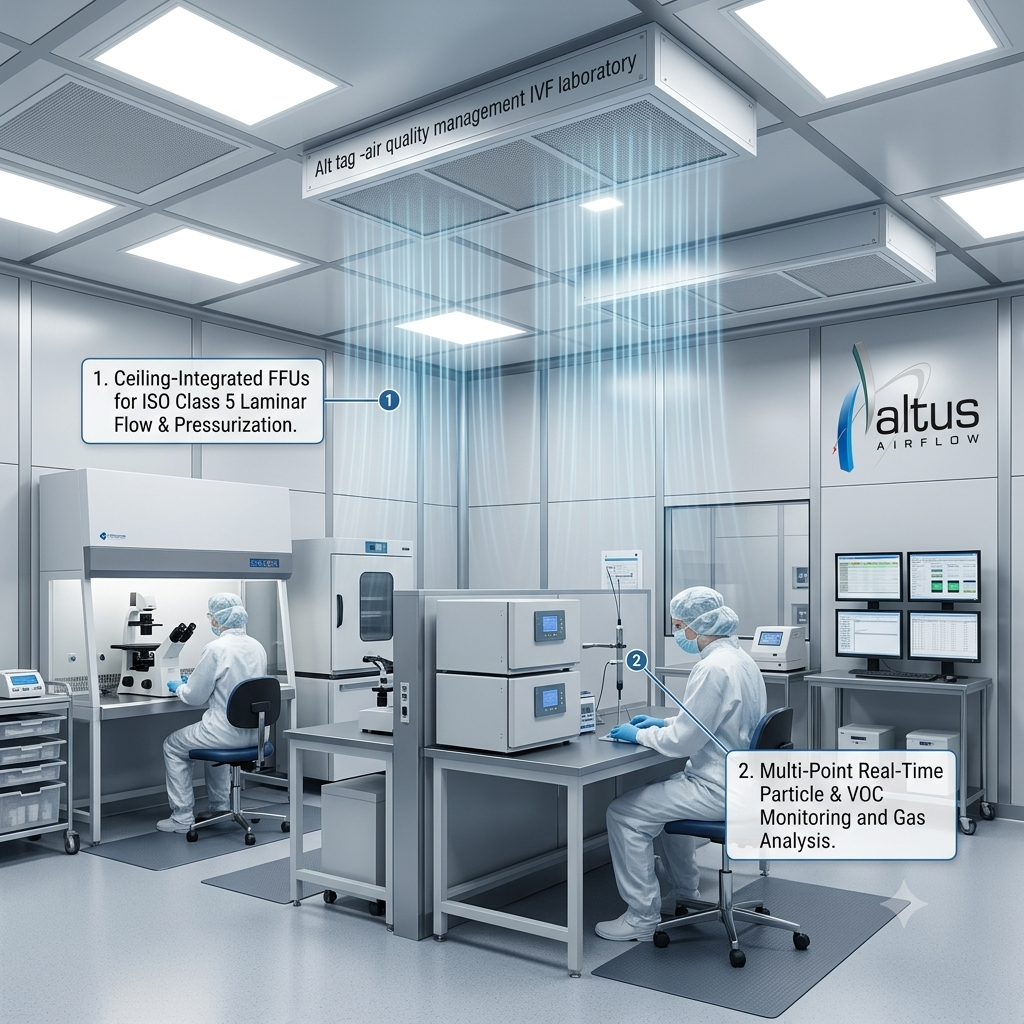
A well-planned IVF Labs Design integrates advanced HVAC systems, HEPA filtration, laminar airflow, pressure management, environmental monitoring, cleanroom engineering, and ventilation strategies to maintain ideal laboratory conditions. Rather than treating air quality as a separate system, professional laboratory designers incorporate it into every stage of engineering—from room layout and equipment positioning to airflow balancing and validation. This comprehensive approach helps ensure consistent laboratory performance, contamination control, regulatory compliance, and long-term operational reliability. This article explains how air quality management influences IVF laboratory design and why it is indispensable for successful fertility treatments.
Importance of Air Quality in IVF Laboratories
Embryos are extremely sensitive to environmental changes.
Poor air quality may affect:
- Embryo development
- Cell viability
- Laboratory consistency
- Clinical outcomes
Maintaining clean air supports successful fertility treatments.
Sources of Air Contamination
Air contamination may originate from:
- Airborne particles
- Dust
- Microorganisms
- Chemical vapors
- Human activity
Proper engineering minimizes contamination risks.
Role of HVAC Systems
HVAC systems form the backbone of modern IVF Labs Design.
They regulate:
- Temperature
- Humidity
- Air circulation
- Ventilation
Stable environmental conditions improve laboratory performance.
HEPA Filtration
Medical-grade HEPA filters remove airborne contaminants.
Common filtration includes:
- H13 HEPA filters
- H14 HEPA filters
High-efficiency filtration significantly improves laboratory air quality.
Laminar Airflow Systems
Laminar airflow delivers highly filtered air in a controlled direction.
Benefits include:
- Uniform airflow
- Reduced turbulence
- Lower contamination levels
Laminar airflow protects sensitive laboratory procedures.
Temperature Stability
Embryo development depends on stable temperatures.
Professional systems maintain:
- Consistent room temperature
- Equipment cooling
- Environmental balance
Stable temperatures improve laboratory reliability.
Humidity Control
Humidity affects laboratory comfort and equipment performance.
HVAC systems maintain controlled humidity levels to:
- Reduce condensation
- Improve equipment reliability
- Support laboratory stability
Humidity management complements temperature control.
Positive Pressure Control
Positive pressure prevents contaminated air from entering clean laboratory areas.
Pressure management helps maintain:
- Cleaner environments
- Stable airflow
- Reduced contamination
Controlled pressure improves cleanroom performance.
Air Change Rates
Fresh filtered air continuously replaces room air.
Proper air changes help:
- Remove airborne particles
- Dilute contaminants
- Maintain cleanliness
Balanced airflow supports embryo protection.
Volatile Organic Compound (VOC) Control
Chemical pollutants may affect embryo development.
Professional IVF Labs Design minimizes VOC exposure through:
- Low-emission materials
- Air purification
- Controlled ventilation
VOC reduction improves laboratory quality.
Cleanroom Engineering
Many IVF laboratories incorporate cleanroom technology.
Cleanroom design supports:
- Particle control
- Surface cleanliness
- Air quality consistency
Cleanroom engineering strengthens contamination prevention.
Airflow Distribution
Air distribution is carefully engineered.
Planning includes:
- Supply air positioning
- Return air placement
- Uniform circulation
Balanced airflow prevents stagnant zones.
Environmental Monitoring
Continuous monitoring ensures stable laboratory conditions.
Monitoring systems measure:
- Temperature
- Humidity
- Pressure
- Air quality
Real-time monitoring allows rapid corrections.
Equipment Placement
Laboratory equipment influences airflow.
Professional planning positions equipment to:
- Prevent airflow obstruction
- Improve accessibility
- Support contamination control
Proper layouts improve efficiency.
Air Handling Units
Air handling units condition laboratory air.
Functions include:
- Cooling
- Heating
- Filtration
- Fresh air supply
Reliable air handling improves laboratory performance.
Ductwork Engineering
Proper duct design ensures efficient airflow.
Engineering focuses on:
- Balanced distribution
- Pressure stability
- Low noise
Efficient ductwork supports HVAC performance.
Laboratory Workflow
Air quality management influences laboratory layout.
Well-designed workflows reduce:
- Cross contamination
- Unnecessary movement
- Air disturbance
Organized layouts improve laboratory efficiency.
Validation Procedures
Every laboratory undergoes validation.
Testing includes:
- HEPA integrity
- Airflow balancing
- Pressure verification
- Particle counting
Validation confirms engineering quality.
Maintenance Programs
Routine maintenance preserves air quality.
Maintenance includes:
- Filter replacement
- HVAC servicing
- Calibration
- Environmental verification
Preventive servicing extends system lifespan.
Backup Systems
Power interruptions can affect environmental stability.
Backup systems protect:
- HVAC operation
- Monitoring equipment
- Critical laboratory infrastructure
Continuous operation improves safety.
Future Expansion
Professional IVF Labs Design supports future upgrades.
Scalable infrastructure accommodates:
- Additional laboratories
- Equipment upgrades
- Expanded workflows
Future-ready planning protects investments.
Benefits of Effective Air Quality Management
Professional air quality engineering provides:
- Better contamination control
- Stable environmental conditions
- Improved embryo protection
- Higher laboratory reliability
- Regulatory compliance
Comprehensive engineering supports long-term laboratory success.
Conclusion
Air quality management is one of the most influential aspects of successful IVF Labs Design because it directly affects embryo safety, laboratory consistency, contamination control, equipment reliability, and clinical outcomes. Through the integration of advanced HVAC systems, HEPA filtration, laminar airflow, pressure management, environmental monitoring, cleanroom engineering, airflow balancing, validation, and preventive maintenance, modern IVF laboratories maintain highly controlled environments that support every stage of assisted reproductive technology. Professional engineering ensures that all environmental systems work together to create reliable laboratory conditions capable of meeting demanding healthcare standards. With specialized cleanroom expertise, advanced environmental engineering, and comprehensive laboratory planning, Altus Airflow delivers IVF laboratory solutions designed for superior performance, long-term reliability, and clinical excellence.
Frequently Asked Questions (FAQs)
1. Why is air quality important in IVF Labs Design?
Air quality is essential in IVF Labs Design because it protects embryos, reduces contamination, and maintains stable laboratory conditions.
2. How does HVAC improve IVF Labs Design?
HVAC systems in IVF Labs Design regulate temperature, humidity, pressure, and airflow to maintain optimal laboratory environments.
3. Why are HEPA filters used in IVF Labs Design?
HEPA filters improve IVF Labs Design by removing airborne particles and maintaining clean laboratory air.
4. Does IVF Labs Design include environmental monitoring?
Yes, professional IVF Labs Design includes continuous monitoring of temperature, humidity, air pressure, and air quality.
5. How does laminar airflow support IVF Labs Design?
Laminar airflow enhances IVF Labs Design by providing highly filtered, unidirectional airflow that minimizes airborne contamination.
Read Our Previous Blog------>What equipment is supplied by a Modular Ophthalmic OT Engineering Company?
 Romaian
 English
 Arabic
 French
 Spanish
 Portuguese
 Deutsch
 Turkish
 Dutch
Dutch
 Italiano
 Russian
 Portuguese (Brazil)
 Greek
Greek