


An Insightful Guide to Midwifery Assignment Structure

Nobody can deny that writing your midwifery assignment sometimes feels equally challenging to working in a practical midwifery setting.
What I mean is, you may be well aware of labour, pregnancy care, and newborn care, but transforming that knowledge into a well-organised midwifery assignment structure is a skill that many students struggle to develop throughout their academic journeys.
While writing your midwifery assignment, you must remember that your assignment checkers expect more than accurate information and mark your assignments based on clear organisation, logical flow, demonstration of your critical thinking, and correct formatting. It means you must compose a well-structured assignment that highlights your ideas and helps the readers to understand your arguments and key findings.
In this guide, you can have a glance at the most common assignment structures to help you learn how to organise your midwifery coursework without making mistakes or losing marks.
Moreover, with these structures, you can meet your university's requirements and achieve academic excellence.
Let us begin this insightful conversation!
Formatting and Structure Examples for Different Assignment Types
As you know, there are different types of assignments, and each is formatted differently. For a reflective assignment, you have to focus on personal experience, while for a literature review, you have to discuss a published study.
Let me help you understand the correct midwifery assignment structure, so you don't make mistakes.
1. Standard Clinical Essay Structure
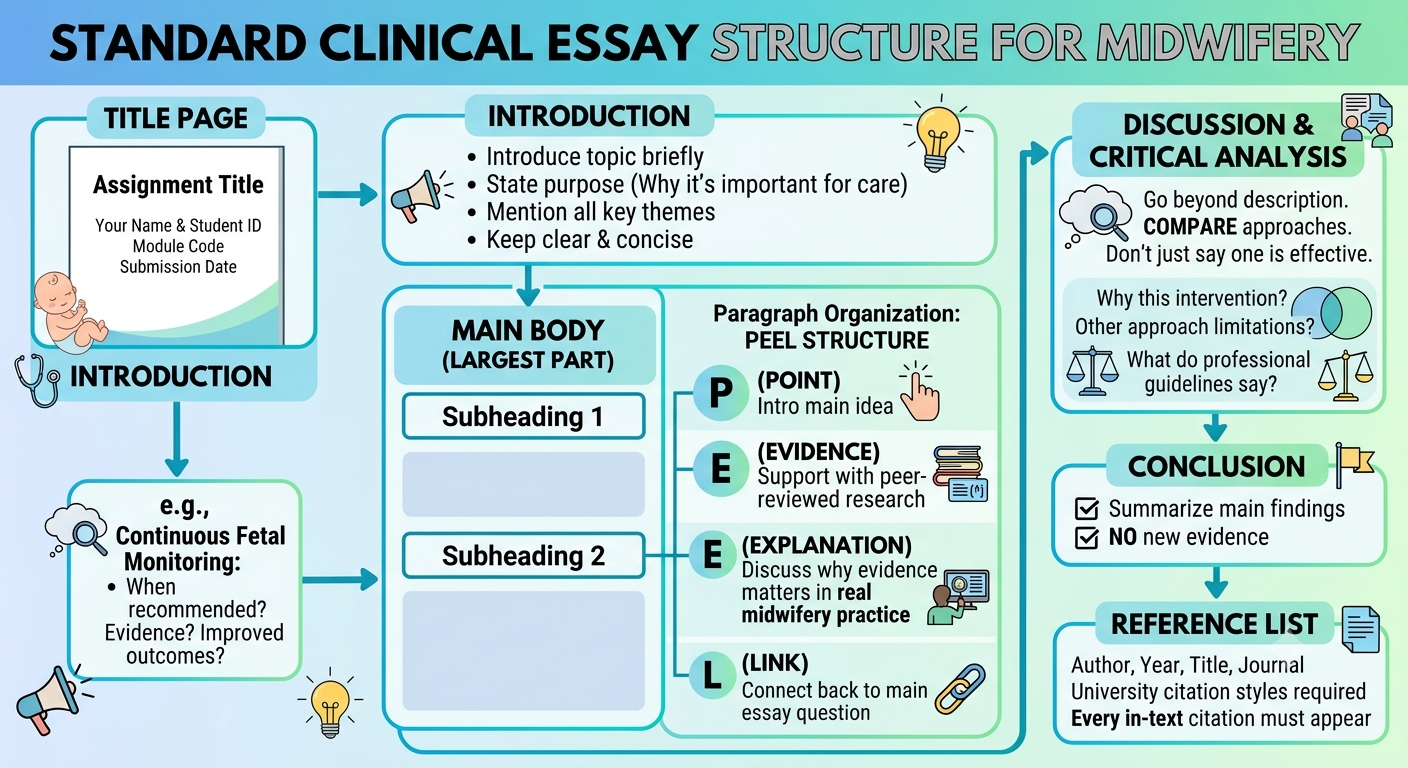
You will probably be assigned a clinical essay when discussing topics such as the stages of labour, breastfeeding, public health issues in midwifery, and maternal health. You will have to write with a purpose to explain, analyse, and critically evaluate a topic using your research-based evidence.
Here’s how you will have to structure your standard essay:
Title Page
You have to start with a title page that includes the following details:
-
Your assignment’s title.
-
Your name and student ID.
-
Module or the specific course code.
-
Submission date.
You must remember to modify or include additional details according to your university’s requirements.
Introduction
Your essay’s introduction will give the readers a clear understanding of what you will discuss. To write a good introduction, you should:
-
Introduce the topic with minimal details.
-
State the purpose of your essay by explaining why it is important in maternal or neonatal care practices.
-
Without in-depth detail, you have to mention all the key themes you will discuss.
-
Don’t forget to keep this section clear and concise.
Main Body
As you already know, this is the largest part of the essay, so you have to divide it into clear subheadings followed by well-organised paragraphs. Here, you have to make sure that your ideas and arguments maintain a logical flow so that anyone reading your essay can follow your discussion.
For your paragraphs, you should use the PEEL (Point, Evidence, Explanation, Link) structure.
In Point, you have to introduce your main idea.
In the Evidence approach, you have to support your idea using peer-reviewed research.
For the Explanation step, discuss why your chosen evidence matters in real-life midwifery practice.
As for the Link step, you have to connect each one of the paragraphs back to your main essay question.
Suppose you are discussing continuous fetal monitoring in your essay. In this case, you will have to explain when it is recommended, what evidence supports its use, and how it can improve neonatal or maternal outcomes.
Discussion and Critical Analysis
You must remember that high-scoring essays require you to do more than just describe information. What I mean is, you have to compare different approaches rather than stating that one intervention is effective.
To ensure a better critical analysis in your essay, you should ask yourself these questions while writing:
-
Why is this particular intervention recommended?
-
In which situations is another approach better, and what are the limitations of the evidence?
-
What do some of the professional guidelines recommend?
Conclusion
For your essay’s conclusion, you have to summarise your main findings without mentioning any new evidence.
Reference List
Finally, finish your essay with a well-formatted reference list and use the citation styles that are required by your university. Here, you have to ensure that every in-text citation appears in your reference list.
2. Reflective Case Study or Portfolio Structure

A reflective midwifery assignment allows you to analyse real-life midwifery experiences and learn from them, and it’s an important part that helps you become a competent midwife.
Don’t confuse a reflective case study with a standard case study, as a reflective case study is based on your personal experience. On the other hand, standard case studies are mainly designed to test theories and analyse data.
For example:
-
How did you assist in a complex birth situation?
-
Your experience at a postnatal home visit.
-
How did you overcome a communication challenge with a patient?
Here’s what your reflective study’s format should include:
Introduction
Here, you have to briefly introduce the midwifery situation and state which of the reflection models you will use, such as:
-
Borton's Reflective Model or the Gibbs Reflective Cycle.
Description
Moving to the description phase, you have to describe what happened during the clinical experience. You must never use real patient names so that you can protect patient confidentiality. Instead, use pseudonyms such as "Mrs A."
Feelings and Evaluation
At this stage of your reflective case study, you have to mention your thoughts and emotions during that particular event. While writing this stage, you should consider questions such as:
-
Were you confident or nervous?
-
What surprised you?
After that, you have to evaluate the situation. And you can do that by:
-
Identifying what went well and what measures could have been improved.
-
Present an honest reflection to demonstrate your professional growth.
Analysis
Remember that section is where you get awarded with most of the marks. Here, you have to explain why you made certain midwifery decisions.
You must support your discussion with:
-
Research evidence based on modern midwifery practice.
-
Professional guidelines from the Nursing and Midwifery Council.
You should also discuss how teamwork influenced patient care in that specific situation.
Conclusion and Action Plan
After these, you have to summarise your learning and explain how the particular experience will improve your future practice.
For example:
-
How did you improve your communication skills?
-
Boost your confidence during emergencies.
-
Strengthen your knowledge of fetal monitoring.
-
Attend more clinical training programs.
3. Literature Review Structure
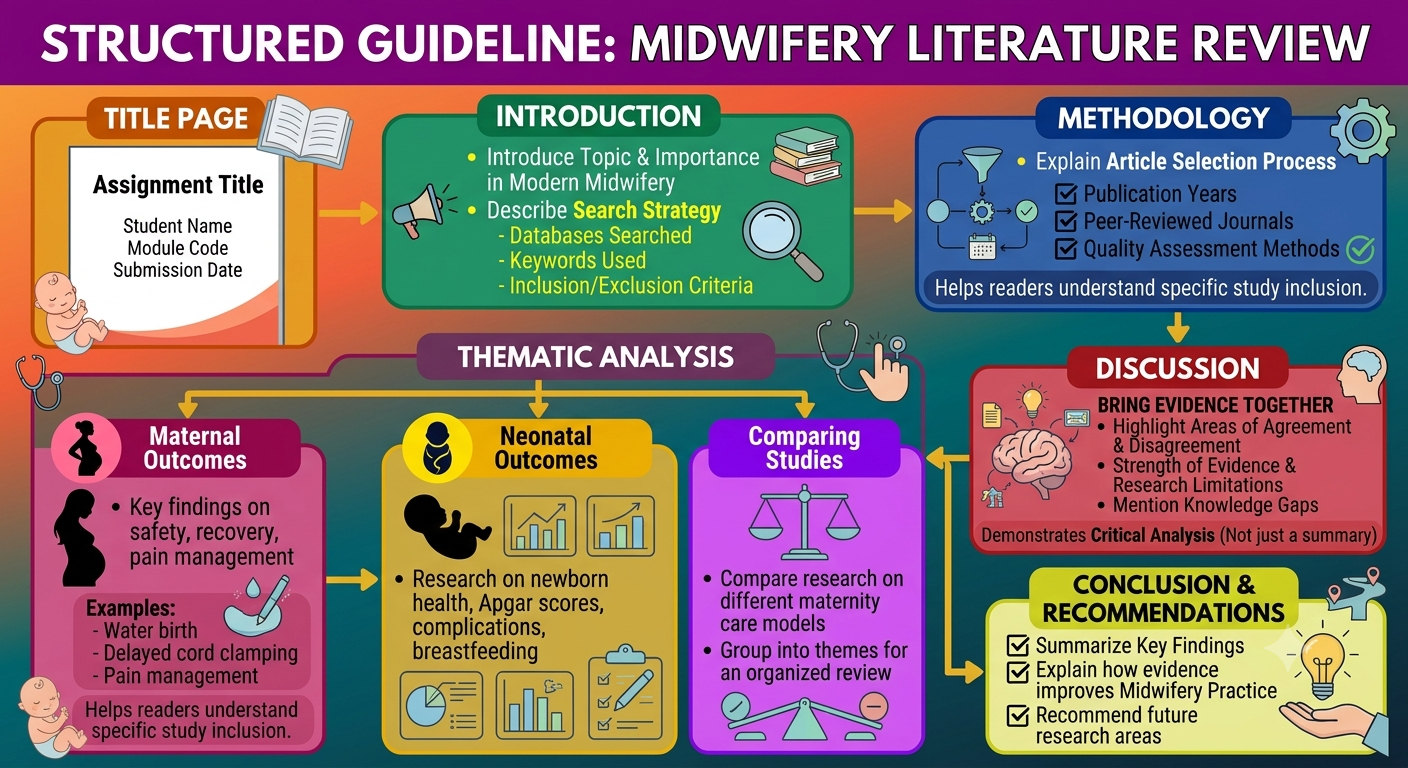
Let me make it simple. For a literature review, you have to analyse published research rather than having to discuss a single patient. Here, your goal will be to compare research studies and identify current evidence.
Among the most common topics are:
-
Water birth.
-
Delayed cord clamping.
-
Breastfeeding support.
-
Pain management during labour.
You will have to include the following components when formatting your literature review:
Introduction
First, begin by introducing your topic and explaining why it is important in modern midwifery. Also, don’t forget to describe your search strategy.
Mention the following:
-
The databases you searched.
-
The keywords you used.
-
Your inclusion criteria.
-
Your exclusion criteria.
Methodology
At this phase of your literature review, you have to explain how you selected the articles for your work.
You have to describe:
-
Publication years, peer-reviewed journals, and the quality assessment methods.
The purpose of this is to help readers understand why you included specific studies.
Thematic Analysis
Don’t know what to write in your thematic analysis? Let me tell you that here you have to organise your research into themes instead of discussing one article after another.
Here are some examples for you:
For Maternal Outcomes
Discuss your key findings that are based on maternal safety, recovery, or pain management.
For Neonatal Outcomes
You have to review research on newborn health, the Apgar scores, neonatal complications, and breastfeeding.
Comparing Studies
In this phase, you have to compare studies that examine different models of maternity care. Also, you have to group studies into themes so that you can create a more organised review.
Discussion
This requires you to bring all pieces of evidence together, and you have to highlight:
-
The areas of agreement and disagreement.
-
The strength of current evidence and the research limitations.
-
Also, mention the knowledge gaps.
It will help you demonstrate your critical analysis rather than simply summarising what you read or understand.
Conclusion and Recommendations
As the name suggests, you have to summarise all of your key findings. Then, you must explain how the evidence can help improve modern midwifery practice. Also, don’t forget to recommend areas where there is a need for future research.
4. Standard Case Study Structure

Unlike a reflective case study, standard case studies examine the complete care of the mother from pregnancy throughout the postnatal period. You have to write while combining your clinical practice with academic analysis.
The midwifery assignment structure for case studies includes the following components:
In the title page, include:
-
Your case study’s title.
-
Your name and student ID.
-
Course information.
-
Instructor’s name.
-
Submission date.
Abstract or Introduction
Here, you have to provide a brief overview of the case and explain the following components:
-
The purpose of your case study.
-
The clinical background.
-
The type of midwifery care provided.
Patient Profile and Consent
Next, you have to introduce the patient's background while maintaining confidentiality and mention the following:
-
Her age.
-
Pregnancy history.
-
All the relevant medical conditions.
The Care Practice
Here, you have to describe the following:
-
The antenatal care and explain why each aspect of care was important in that situation.
-
For the intrapartum management, you have to describe labour and birth and back up your discussion with the latest clinical evidence.
-
Explain postnatal care, including maternal recovery and show how ongoing care supports positive outcomes for mother and baby.
Discussion and Evidence-Based Analysis
This one is the most important, as you have to analyse whether the care followed the latest midwifery guidelines and compare practice with the published research. Also, you will have to identify the strengths, challenges, and potential areas for improvement.
At this stage, you should avoid simply describing the events and explain why certain clinical decisions were appropriate in a particular situation.
Conclusion or Summary
Present your closing statement by summarising the patient’s outcomes. Also, remember to evaluate the overall effectiveness of the entire care process, but keep this section concise and to the point.
Reference List
At the end, you have to include every source you have cited within your assignment. Here, you must use your attention to detail and double-check formatting before you submit, as incorrect referencing is among the common midwifery assignment mistakes that lead to deductions.
Tips for Writing High-Scoring Midwifery Assignments
To compose a well-written assignment, regardless of the assignment type, you should follow these insightful tips:
-
Carefully read the marking rubric before you write, and make sure to answer your assignment question directly and follow your university’s guidelines.
-
Make sure to use the 5-year rule to research the latest sources.
-
Write in a coherent academic tone and use clear headings and subheadings to maintain a smooth midwifery assignment structure.
-
Don’t forget to support your clinical arguments with credible evidence.
-
Make sure to link each piece of your evidence back to your main argument.
-
Proofread your work carefully before you submit your assignment.
These can help you write a high-scoring midwifery assignment without making structural mistakes or any other blunders.
Frequently Asked Questions
Why is assignment structure so important in midwifery coursework?
With a clear structure, you can make it easier for your assignment markers to understand your ideas. Remember that even if you include strong clinical knowledge in your work, you can still end up receiving lower grades if your assignment’s structure is disorganised.
Can I include my personal opinion in reflective assignments?
Yes, you can include your opinions, but you must ensure they are linked to professional reflection, research evidence, and ethical standards.
What is the biggest mistake midwifery students make in their assignments?
A majority of students spend too much time describing events rather than critically analysing the situations, which is why they end up scoring lower marks.
How can I improve my assignment grades?
You should plan your structure before writing, use the latest evidence, proofread your work, and follow your assignment’s grading rubric carefully. It can help you improve your content’s quality and boost your scores.
The Final Word
Above all, you should understand that writing your midwifery assignments does not revolve around understanding the midwifery care practices. Instead, you are required to present your ideas clearly, support your claims with credible evidence, and organise your work while following the correct midwifery assignment structure.
By presenting your work in the right format, whether you are writing a clinical essay, a reflective case study, or a literature review, you can increase your chances of scoring higher grades and achieving academic excellence.
Good luck writing your midwifery assignments!
 Romaian
 English
 Arabic
 French
 Spanish
 Portuguese
 Deutsch
 Turkish
 Dutch
Dutch
 Italiano
 Russian
 Portuguese (Brazil)
 Greek
Greek