


How To Evaluate Healthcare AI Solutions Without Getting Burned By Vendor Claims?
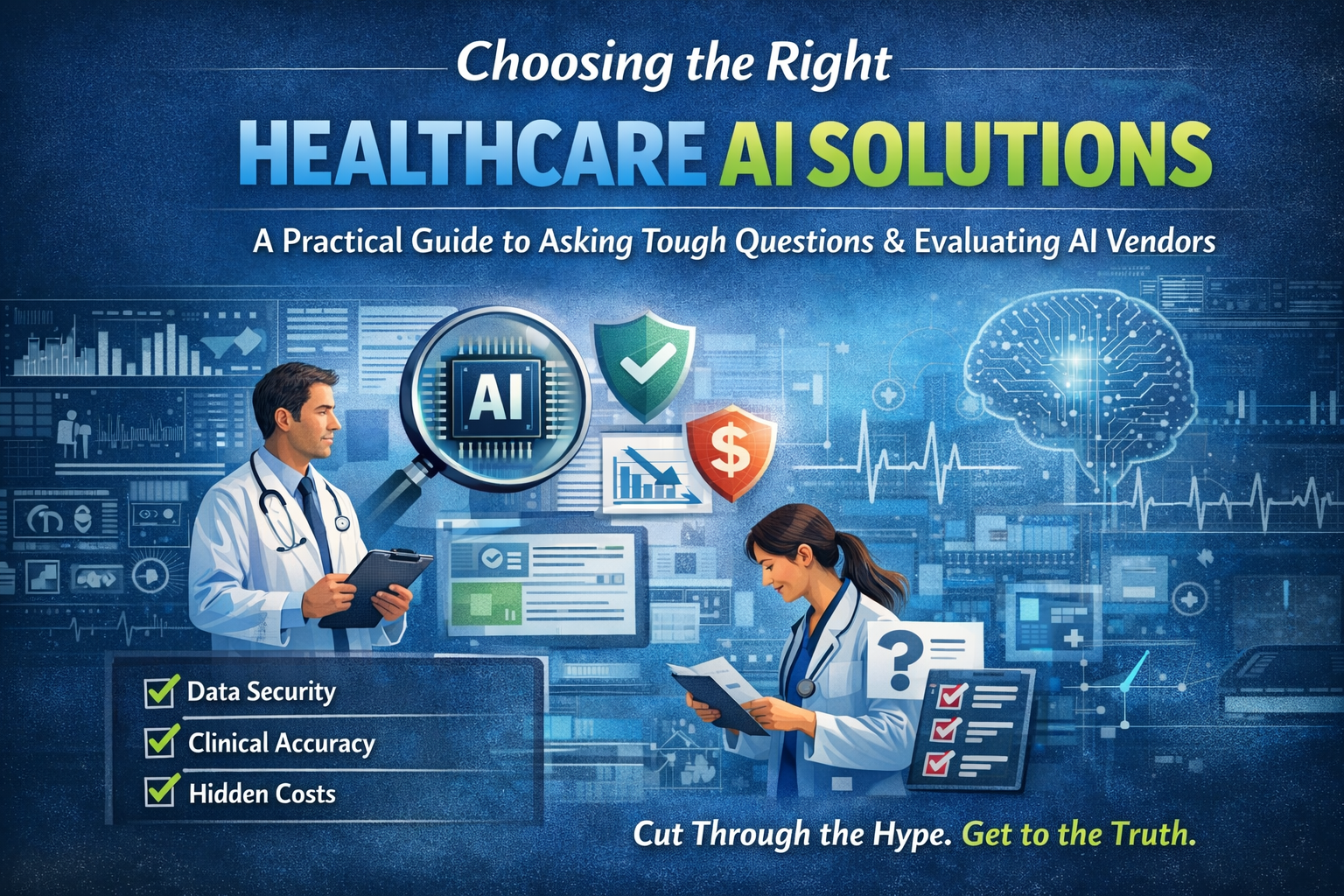
Many vendors promise transformation. "AI-powered." "Real-time intelligence." "Outcome-driven." But in healthcare, the wrong technology choice affects your budget, patient care, compliance, and organizational trust. Picking the right Healthcare AI Solutions requires more than sitting through a polished demo.
The real work happens before you sign anything. It means asking harder questions, stress-testing vendor claims, and understanding exactly what's powering the platform underneath. This guide gives you a practical, no-fluff framework for doing exactly that.
Data Quality Comes First
Before evaluating features, evaluate data. Every healthcare AI model is only as reliable as what it was trained on, and many vendors do not provide enough detail on this.
What to Ask About Training Data
-
What data sources power the model? Claims, EHRs, labs, or clinical notes?
-
Does it include social determinants of health (SDoH)?
-
How frequently is the model updated with new data?
-
Has it been validated on real-world patient populations?
Vague answers like "proprietary datasets" without specifics are a red flag. Precision in data equals precision in output.
Workflow Integration Real vs. Claimed
Vendors claim seamless integration. Real integration means care teams act on AI insights within their existing workflows, without requiring users to switch systems, export data, or rely on static reports.
What Genuine Integration Looks Like
-
AI alerts surface inside existing EHR and care management systems
-
Recommendations are contextual and actionable, not just informational
-
Non-technical users can query data without IT involvement
-
Onboarding and staff training are part of the package, not an add-on
If "integration" means downloading a report into a spreadsheet, that's a workaround dressed up as a feature.
Transparency: The Black Box Problem
This is where many platforms fail. Healthcare AI can't operate as a black box. When a model flags a patient as high-risk or recommends a specific discharge path, clinicians need to understand why, for trust and regulatory accountability.
Signs of a Transparent AI Platform
-
The vendor can explain model logic in plain, non-technical language
-
There's a clear audit trail for AI-generated recommendations
-
Confidence scores or uncertainty ranges are visible to users
-
The system handles conflicting or incomplete data with clear flags
Clinicians won't act on recommendations they can't verify. A non-transparent tool becomes shelfware fast.
Customization vs. Generic Models
Many AI models are designed for generalized use cases. Your patient population is not average. A community health system serving rural Medicaid patients has completely different needs than a large Medicare Advantage plan.
The right vendor asks about your population before pitching a solution. They tailor models to your data environment, workflows, and goals. That's the difference between a digital health platform that adds noise and one that drives outcomes.
Here's what real customization includes:
-
Models retrained or fine-tuned on your specific population data
-
Configurations built for your organization type: ACO, payer, provider, or hospital system
-
Specialty-specific workflows, not a one-size-fits-all dashboard
-
Ongoing model optimization after go-live, not just implementation and exit
Running a Pilot the Right Way
No vendor pitch replaces a real-world test. A 60–90 day structured pilot will tell you more than a year of sales conversations.
Set it up properly:
-
Define success metrics upfront: Such as readmission rates, cost per member, and care gap closures
-
Involve end users from day one: Care managers and clinicians, not just IT
-
Compare against your own baseline: Not vendor-supplied benchmarks
-
Document friction points: Slow performance, confusing UI, and data gaps can impact performance at scale
-
Check vendor responsiveness: How quickly do they resolve issues during the pilot?
A confident vendor typically supports a pilot. Hesitation should be evaluated carefully.
Takeaway
Choosing the right Healthcare AI Solutions is about cutting through noise and finding a platform that's honest about its data, transparent in its logic, and built to fit your workflows, not the other way around.
Persivia offers an AI-driven platform designed for healthcare, supporting clinical documentation, cost prediction, discharge planning, and natural language data access. The platform brings together population health data, AI capabilities, and workflow-based insights across payer, provider, and ACO environments, supported by over 15 years of data experience.

 English
 Arabic
 French
 Spanish
 Portuguese
 Deutsch
 Dutch
Dutch
 Italiano
 Russian
 Romaian
 Portuguese (Brazil)
 Greek
Greek