


Top 5 Things to Look for in a Healthcare Data Aggregation Platform in 2026
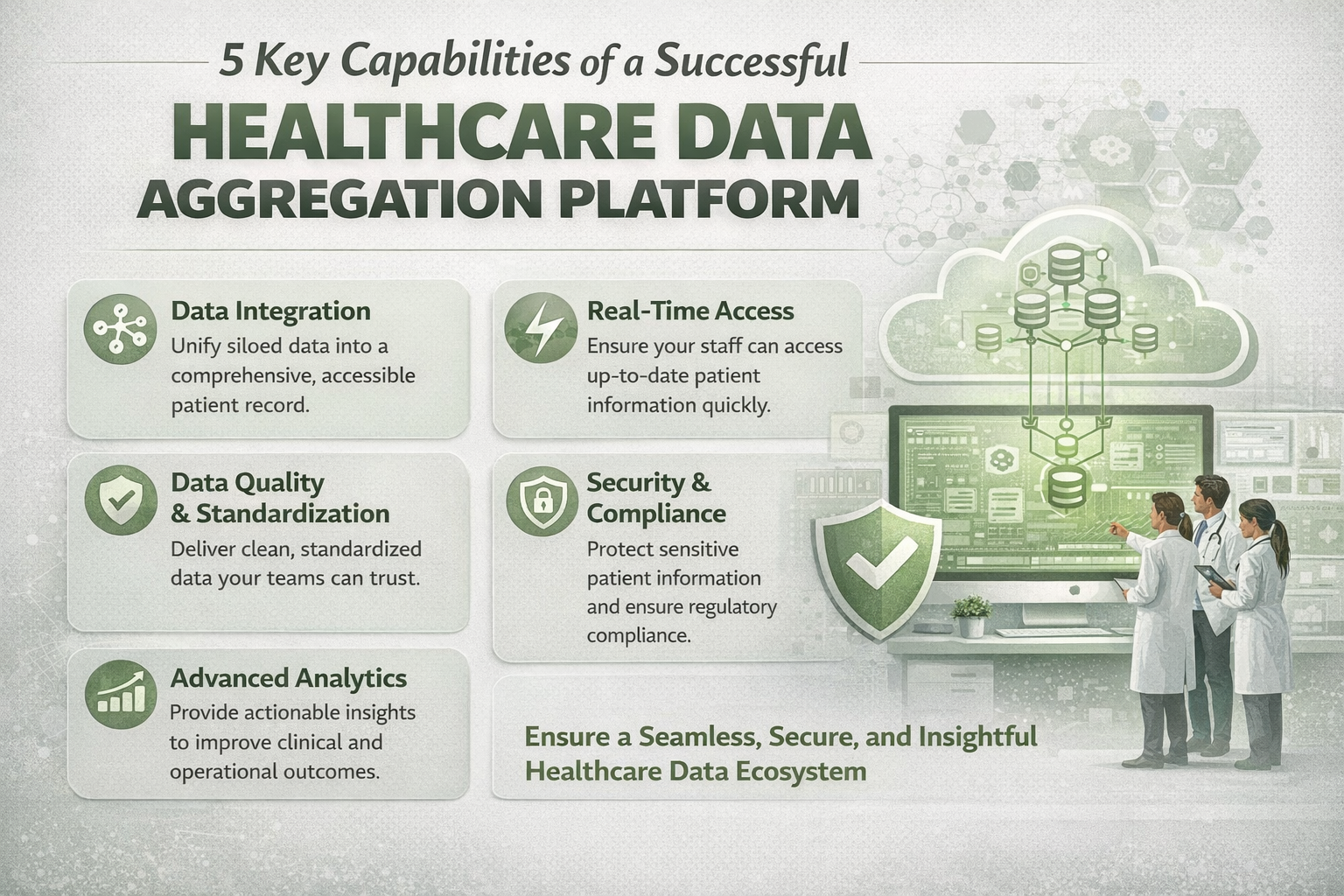
Most health care organizations are creating more data than ever, but most of it remains hidden and in silos, unused. This is where the right Healthcare Data Aggregation Platform makes the difference. It determines how clearly your teams can view each patient without wasting time navigating fragmented systems.
The difference between a capable platform and one that only looks good on paper comes down to five key capabilities. Whether you are selecting a new solution or reassessing your current system, these are the capabilities to focus on and why they matter.
1. A Unified Data Model Covering Every Source
A Unified Data Model (UDM) standardizes inputs from multiple sources into one consistent structure so nothing gets lost between systems.
What It Should Cover
A strong UDM handles far more than EHR data. Look for a platform that pulls from:
-
EHRs: Structured clinical data from care encounters
-
Medical claims: Procedures, diagnoses, and cost data
-
SDOH: Housing, income, and social risk factors
-
ADT feeds and HIE data: Real-time admission and discharge alerts
-
Patient-reported outcomes: Self-reported health information
-
Home device and wearable data: Remote monitoring inputs
-
Administrative data: Enrollment, eligibility, and coverage
It should support both overnight and real-time processing, since care decisions cannot wait for delayed data refresh cycles.
2. A Data Lakehouse Architecture
Storage alone is not a strategy. The architecture underneath a healthcare data platform determines how fast, flexible, and reliable your data operations actually are, and a data lakehouse is the architecture built for the 2026 demands.
Why Lakehouse Beats Lake or Warehouse Alone
A data lakehouse combines the performance of a data warehouse with the flexibility of a data lake for handling raw data. Raw data is ingested quickly, processed through curation pipelines, and delivered as clean, optimized datasets for analytics and clinical use. You get:
-
Ad-hoc data exploration alongside production analytics on the same system
-
No forced tradeoff between flexibility and performance
-
A full data pipeline from raw ingestion to insight delivery
3. Advanced Data Curation and a Longitudinal Patient Record
Aggregating data is step one. Making it accurate and usable is where most platforms fall short. A Healthcare Data Aggregation Platform should process incoming data through three core curation engines before it reaches your teams.
The Three Engines That Build a Clean Patient Record
A Longitudinal Patient Record (LPR), a single, continuously updated view of each patient across all sources, is only as reliable as the curation behind it:
|
Engine |
What It Does |
|
Natural Language Processing (NLP) |
Extracts structured clinical meaning from unstructured notes and free-text fields |
|
Semantic Normalization Engine |
Resolves coding inconsistencies across systems into a common clinical language |
|
Enterprise Master Patient Index (eMPI) |
Matches and deduplicates records so each patient has one accurate, unified file |
Without all three, you end up with gaps, duplicates, and records your clinicians can't fully trust.
4. AI and Machine Learning Embedded in the Core
There is a clear difference between a platform with isolated AI features and one where AI is integrated into data processing. Data aggregation in healthcare delivers its full value only when the LPR flows directly into an AI engine that enriches it automatically and continuously.
What a Built-In AI Layer Should Deliver
Once a patient record is curated, the AI engine should append:
-
HCC code identification: surfacing risk-relevant diagnoses for accurate risk adjustment
-
Care gap alerts: flagging missing screenings, preventive care, or follow-ups
-
Program eligibility flags: auto-identifying patients for care management programs
-
Predictive risk stratification: ML-based scoring by clinical risk and projected cost
-
Automated tasks and goals: actionable next steps generated without manual configuration
Your team should not need to define rules for every scenario manually. The AI runs in the background, keeping insights current as data flows in.
5. Operationally Ready Data for Clinical Teams
A platform is only as valuable as what your teams can actually do with the output. The final test of any health data aggregation solution is whether insights land in the hands of care managers, quality teams, and clinicians without a data engineering team in between.
Where the Data Should Flow
The insight-driven patient record should connect directly to:
-
Care coordination workflows: so teams can act on risk flags immediately
-
Quality management programs: HEDIS gaps, measure performance, and compliance tracking
-
Cost and utilization analytics: clear visibility into where spend is going
-
Provider-facing point-of-care tools: relevant patient context surfaced at the right moment
-
Patient engagement: personalized outreach based on individual risk and care gaps
Real-time deployment of insights into operations should be a standard capability, not an optional add-on.
Bottom Line
The best healthcare data platforms go beyond basic organization, unifying data, using lakehouse architecture, creating accurate patient records, and applying AI to deliver actionable insights in real time. Persivia does exactly this by integrating data from multiple sources, curating it into longitudinal records, and using AI to generate insights like HCC coding and care gap alerts, all accessible to clinical and operational teams through its platform.

 Arabic
 French
 Spanish
 Portuguese
 Deutsch
 Turkish
 Dutch
Dutch
 Italiano
 Russian
 Romaian
 Portuguese (Brazil)
 Greek
Greek