


What a Professional HVAC Cost Estimate Actually Looks Like
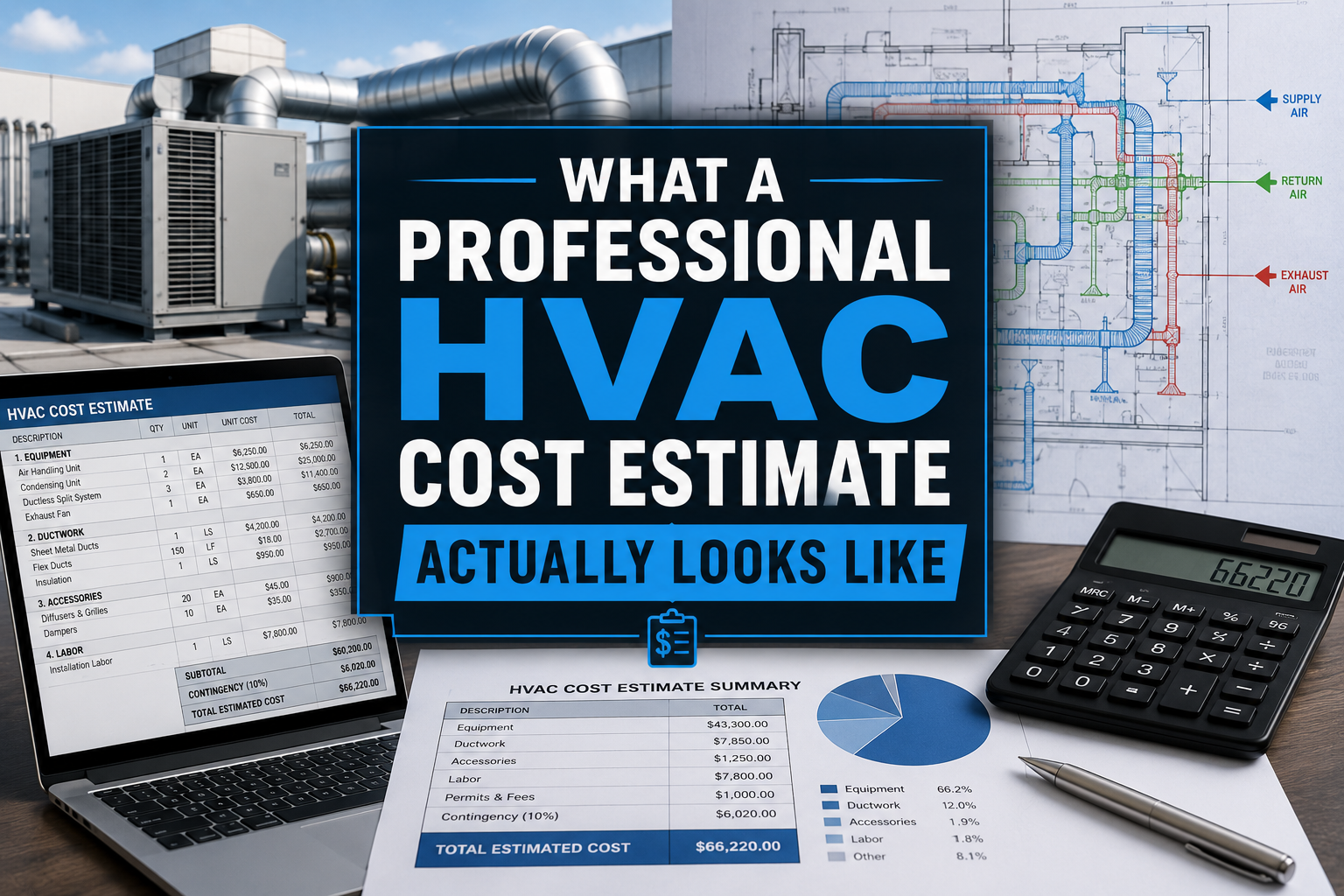
Anyone who has priced out a mechanical scope on their own knows the frustration. You get a rough number from a supplier catalog, another number from a contractor's gut feeling, and a third number that shows up once the bids come in, and none of them agree with each other. The gap usually comes down to one thing: a real HVAC estimate is built line by line, not guessed at from a square footage average.
This article breaks down what actually goes into a professional mechanical estimate, why the format matters as much as the numbers, and what to look for if you want to compare your own project against an accurate benchmark.
Why HVAC Estimating Is Harder Than It Looks
Heating, ventilation, and air conditioning scopes involve more moving parts than most other trades. A single floor of a mid-size building can include dozens of diffuser sizes, multiple duct dimensions, air handling units, condensing units, dampers, grilles, and controls, each with its own labor hours, material cost, and equipment cost. Miss even a handful of line items and the total swings enough to blow a budget.
Every Component Has Its Own Cost Structure
A supply diffuser isn't priced the same way as a length of round duct, and a rooftop air handling unit isn't priced the same way as a fire damper. Each item on a real takeoff carries its own quantity, unit of measure, labor rate, material cost, and equipment cost. That's why a single average "cost per square foot" number for HVAC work is almost always misleading; it hides dozens of smaller decisions that actually drive the total.
Labor Hours Matter as Much as Material Price
Material pricing gets most of the attention, but labor hours are just as important to a mechanical estimate. Installing hundreds of feet of ductwork in tight ceiling spaces takes meaningfully more labor than an open mechanical room, and that difference has to be reflected in the man-hour calculations, not just the material line.
What a Real Line-Item Estimate Includes
Division-Based Organization
Professional estimates are typically organized by CSI division, separating general requirements from HVAC-specific scope. This keeps mobilization, supervision, permits, and overhead items distinct from the actual mechanical equipment and ductwork, so nothing gets buried or double-counted.
Quantity, Unit, and Rate Breakdown
Each line item lists a quantity, a unit of measure (each, square foot, linear foot), a labor rate per hour, a material cost per unit, and an equipment cost per unit where applicable. Multiplying those out and rolling them up gives a subtotal that's traceable back to the individual components, not just a lump-sum guess.
Ductwork Measured by Size and Length
Metal and round ductwork are broken down by exact dimensions, whether that's a 12x10 rectangular run or an 8-inch round duct, along with linear footage and weight. This level of detail matters because duct sizing directly affects both material cost and the labor required for fabrication and installation.
Equipment Scheduled by Model and Capacity
Air handling units, condensing units, exhaust fans, and louvers are typically scheduled by manufacturer, model number, and capacity (measured in CFM). This isn't just for pricing accuracy. It also gives the project team a clear record of exactly what equipment was priced into the bid.
Overhead, Profit, and Wastage Factored In
A complete estimate doesn't stop at raw material and labor totals. Material wastage percentages and contractor overhead and profit are added at the end, which is often where a rough DIY estimate falls apart, since these final adjustments can shift the grand total more than people expect.
Seeing the Format in Action
Reading about an estimating format only goes so far. It's much easier to understand once you see one laid out in full. This sample HVAC cost estimate shows exactly how a real mechanical takeoff is structured, from general requirements through diffusers, ductwork, and major equipment, all the way down to the final overhead and profit calculation.
Final Thoughts
A trustworthy HVAC estimate isn't a single number pulled from a rule of thumb. It's a detailed accounting of every diffuser, duct run, and piece of equipment that goes into a mechanical scope, priced out with real labor hours and material costs. Whether you're a contractor building your own bid or an owner trying to sanity-check a number you've been given, understanding this level of detail is the difference between a budget that holds up and one that falls apart halfway through construction.
 Spanish
 English
 Arabic
 French
 Portuguese
 Deutsch
 Turkish
 Dutch
Dutch
 Italiano
 Russian
 Romaian
 Portuguese (Brazil)
 Greek
Greek