


The Digital Brain and Body: Deconstructing the Robotics Technology Platform
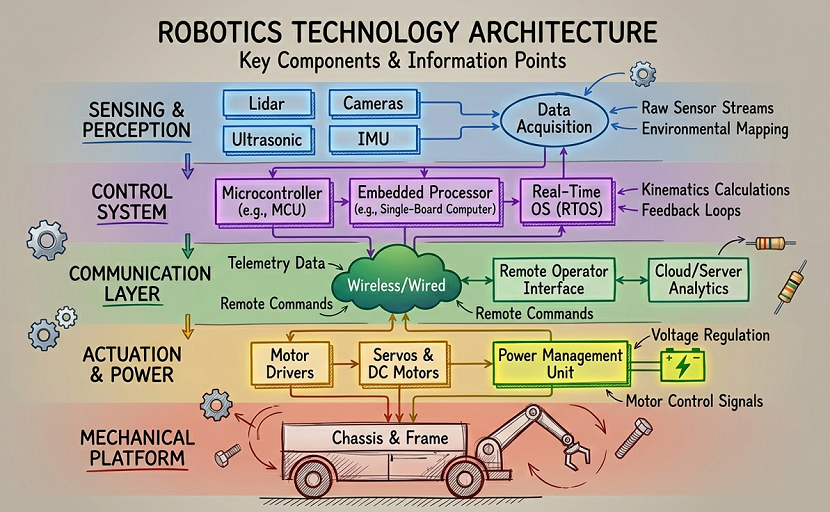
The modern robot is a complex marvel of engineering, a system where the physical "body" and the digital "brain" must work in perfect harmony. The Robotics Technology Market Platform is best understood as a multi-layered architecture that encompasses the hardware, the operating system, and the application-specific software. The hardware platform forms the physical foundation. This includes the mechanical structure of the robot itself—the articulated arm, the mobile base, or the humanoid frame. It also includes the crucial electromechanical components that enable movement: the electric motors, the precision gearboxes, and the actuators that translate electrical signals into physical motion. The sensory system is another key part of the hardware platform, comprising a suite of sensors that allow the robot to perceive its environment. This can include 2D and 3D cameras for vision, LiDAR for mapping and navigation, force-torque sensors for a sense of touch, and proprioceptive sensors that tell the robot the position of its own joints. The integration and quality of these hardware components determine the robot's physical capabilities—its strength, speed, precision, and sensory acuity.
The next layer is the robotics operating system and control software, which acts as the central nervous system. The Robot Operating System (ROS), an open-source framework, has become the de facto standard for a vast number of research and commercial robots. ROS provides a set of libraries and tools that simplify the complex task of creating robot software. It offers standardized "drivers" for common hardware components, tools for visualizing sensor data, and a messaging architecture that allows different software modules to communicate with each other. On top of this operating system runs the real-time control software. This is the low-level code that takes high-level commands (like "move hand to this position") and translates them into the precise electrical signals needed to drive the motors, constantly monitoring sensor feedback to ensure the movement is accurate and stable. This software platform is what abstracts away the complexity of the hardware, providing a more accessible environment for developing higher-level applications.
The intelligence and application layer is where the robot's "brain" and its specific skills reside. This is the software that defines what the robot actually does. For an autonomous mobile robot (AMR) in a warehouse, this layer includes the navigation and path-planning software, often using algorithms like SLAM (Simultaneous Localization and Mapping) to build a map of the environment and navigate through it. For a robot arm performing a pick-and-place task, this layer includes the AI-powered computer vision software that identifies objects, and the motion planning software that calculates a collision-free path for the arm to follow. This layer is increasingly dominated by AI and machine learning. A robot might be "trained" in a simulation environment before being deployed in the real world, or it might use reinforcement learning to improve its performance on a task over time. This application-specific software platform is what gives the robot its purpose and its ability to perform useful work.
The entire robotics platform is increasingly moving towards a more integrated and user-friendly model. In the past, programming a robot required a team of specialized engineers writing complex code. Today, the trend is towards low-code or no-code programming interfaces. For collaborative robots, this might involve a graphical interface where a user can drag and drop commands, or even a "lead-through" programming mode where an operator physically moves the robot arm through the desired motions, and the robot records and repeats the path. Cloud-based platforms are also emerging, allowing for remote monitoring of entire fleets of robots, the collection and analysis of performance data, and the deployment of software updates from a central location. This focus on creating a more accessible, manageable, and intelligent platform is key to democratizing robotics and accelerating its adoption across a wider range of industries.
Explore More Like This in Our Regional Reports:
Italy Centralised Workstations Market

 English
 Arabic
 French
 Spanish
 Portuguese
 Turkish
 Dutch
Dutch
 Italiano
 Russian
 Romaian
 Portuguese (Brazil)
 Greek
Greek