


Flexible Glass Market Size to Reach $107 Billion by 2036
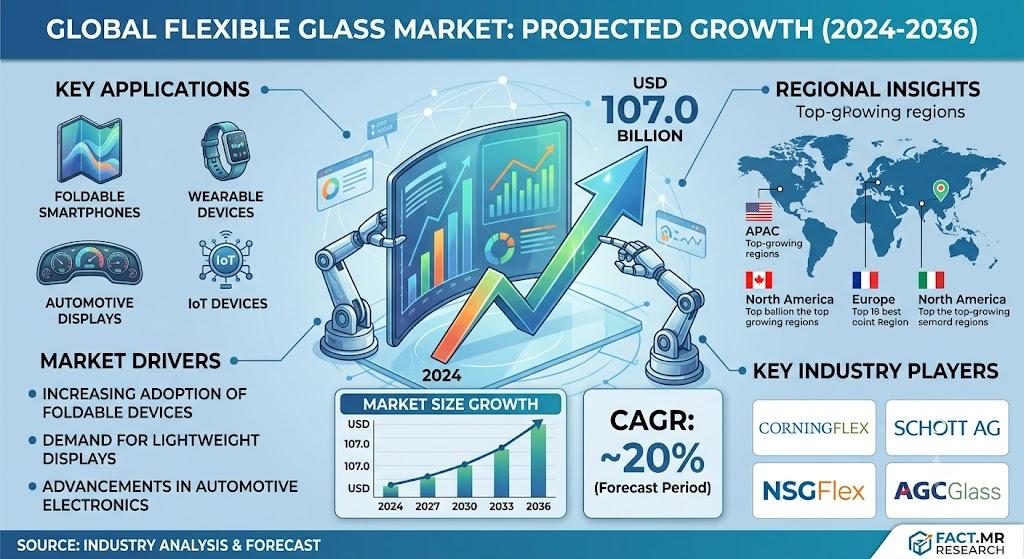
ROCKVILLE, Md., Aug. 27, 2026 — The global flexible glass for flexible electronics market was valued at USD 41.9 billion in 2025, is estimated to reach USD 45.6 billion in 2026, and is forecast to expand to USD 107.0 billion by 2036 at an 8.9% CAGR, according to a comprehensive study by Fact.MR. The market will generate USD 61.4 billion in incremental revenue across the 10-year forecast period.
Rapid adoption of foldable smartphones and expansion of OLED display panels drive this market growth. Manufacturers are shifting away from polymer films because flexible glass delivers superior scratch resistance, higher brightness, and better optical clarity. Premium device makers use ultra-thin glass under 0.1 mm thickness to boost screen durability and fold resistance. Consumers willingly pay 30% to 50% price premiums for flagship foldable devices with genuine glass screens. At the same time, expanding automotive OLED dashboards and medical devices create new industrial demand for ultra-thin glass substrates.
Industry investments and major research programs confirm this structural shift toward glass substrates. According to company data reported by Fact.MR, Samsung Display invested KRW 6.2 trillion in 2024 to expand OLED manufacturing capacity at its Asan facility to support foldable device lines. In material development, Nippon Electric Glass (NEG) introduced ultra-thin 30-micron glass in 2024 for advanced flexible displays and wearables. Additionally, public research initiatives are accelerating material integration; Horizon Europe allocated EUR 45 million in 2024 for flexible materials research to support industrial and automotive electronics applications.
Get detailed market forecasts, competitive benchmarking, and pricing trends: https://www.factmr.com/connectus/sample?flag=S&rep_id=14654
Key-Numbers Table
|
Metric |
Details (Source: Fact.MR) |
|
Market Value (2025) |
USD 41.9 billion |
|
Estimated Value (2026) |
USD 45.6 billion |
|
Forecast Value (2036) |
USD 107.0 billion |
|
Forecast CAGR (2026–2036) |
8.9% |
|
Incremental Revenue (2026–2036) |
USD 61.4 billion |
Segment Breakdown
-
Application Segments: According to Fact.MR, consumer applications represent 68% of total market value in 2026. High demand for foldable smartphones, OLED panels, and premium wearables drives this segment. Industrial and automotive applications are also expanding as automakers deploy curved OLED displays and infotainment stacks.
-
End-User Verticals: The smartphones and tablets category holds a 38% share in 2026, based on Fact.MR findings. Major smartphone OEMs, including Samsung, Google, and Apple, continue to integrate flexible glass cover layers and display substrates to improve product lifecycles.
-
Substrate Formats: Ultra-thin glass engineered below 100 microns—and increasingly below 50 microns—commands premium adoption over legacy polymer polyimide (PI) films. Glass offers better moisture barrier protection and prevents display creasing.
Country CAGR Table (2026–2036)
|
Country / Region |
Forecast CAGR (Source: Fact.MR) |
|
United States |
11.6% |
|
South Korea |
11.5% |
|
Japan |
11.3% |
|
European Union |
11.0% |
|
United Kingdom |
10.8% |
Competitive Landscape
The global supply ecosystem remains highly concentrated among leading glass technology innovators and display manufacturers. Key market participants profiled by Fact.MR include Corning Incorporated, AGC Inc., Nippon Electric Glass (NEG), Schott AG, Saint-Gobain, Asahi Glass Co., BOE Technology Group, Samsung Corning Precision Materials, and Apple Inc. (through patent developments).
Corning drives market expansion through its Gorilla Glass Victus flex program for consumer devices and AR wearables. Schott AG leads in automotive-grade flexible glass qualifications with major European OEMs. AGC and NEG maintain strong leadership in precision ultra-thin glass drawing and substrate supply across East Asia. Specific market share distributions and production volume allocations for each company are available within the full study.
Analyst Quote
"Foldable devices and OLED transitions are accelerating the shift toward flexible glass as polymer alternatives fail to meet durability and performance needs. Flexible glass has evolved into a commercially viable material for foldable electronics. It addresses key limitations of polymer films, especially in durability and optical clarity, enabling 30% to 50% price premiums in flagship devices."
— Shambhu Nath Jha, Lead Analyst at Fact.MR
Frequently Asked Questions (FAQ)
-
What is the flexible glass for flexible electronics market size?
According to Fact.MR, the global market is estimated at USD 45.6 billion in 2026 and is projected to expand to USD 107.0 billion by 2036. -
Why is flexible glass replacing polymer films in foldable phones?
Flexible glass delivers superior scratch resistance, better fold resistance, higher optical clarity, and stronger moisture barrier protection compared to plastic films. -
Which country shows the fastest growth in the flexible glass market?
The United States leads all countries with a projected 11.6% CAGR from 2026 to 2036, followed closely by South Korea at 11.5%, based on Fact.MR research. -
What application holds the largest market share?
Consumer applications hold a dominant 68% market share in 2026, led by foldable smartphones, tablets, and OLED wearables.
Top Trending Reports:
https://www.openpr.com/news/4400125/polyvinyl-alcohol-market-forecast-2026-2036-market-to-reach
https://www.openpr.com/news/4400127/benzyl-chloride-market-forecast-2026-2036-market-to-reach-usd
https://www.openpr.com/news/4400128/pharmaceutical-packaging-market-forecast-2026-2036-market
https://www.openpr.com/news/4400129/carbon-black-market-forecast-2026-2036-market-to-reach-usd-52-7
About Fact.MR
Fact.MR is a global market research and consulting firm trusted by Fortune 1,000 companies and industrial leaders for actionable market intelligence and proprietary forecasting models. Learn more by exploring the complete

 English
 Arabic
 Spanish
 Portuguese
 Deutsch
 Turkish
 Dutch
Dutch
 Italiano
 Russian
 Romaian
 Portuguese (Brazil)
 Greek
Greek